
Microgrids, Infrastructure Resilience, and Advanced Controls Launchpad (MIRACL)
We are enabling distributed wind energy resources to remain resilient in the face of cyberattacks to ensure the reliability of wind generation.
The U.S. energy infrastructure has become a major target of frequent and sophisticated cyber-attacks. Distributed Wind (DW) energy provides an affordable, accessible and compatible distributed energy resource to local grid operations. As DW expands from a local provider to an aggregate generation resource, the DW community must improve its resilience and cybersecurity posture. By utilizing tools and methodologies that tackle DW vulnerabilities, we can advance the reliability of DW within the larger energy sector.
About MIRACL
U.S. energy infrastructure has become a major target of cyber attacks.
There are currently no consistent or generally accepted cybersecurity standards for distributed wind.
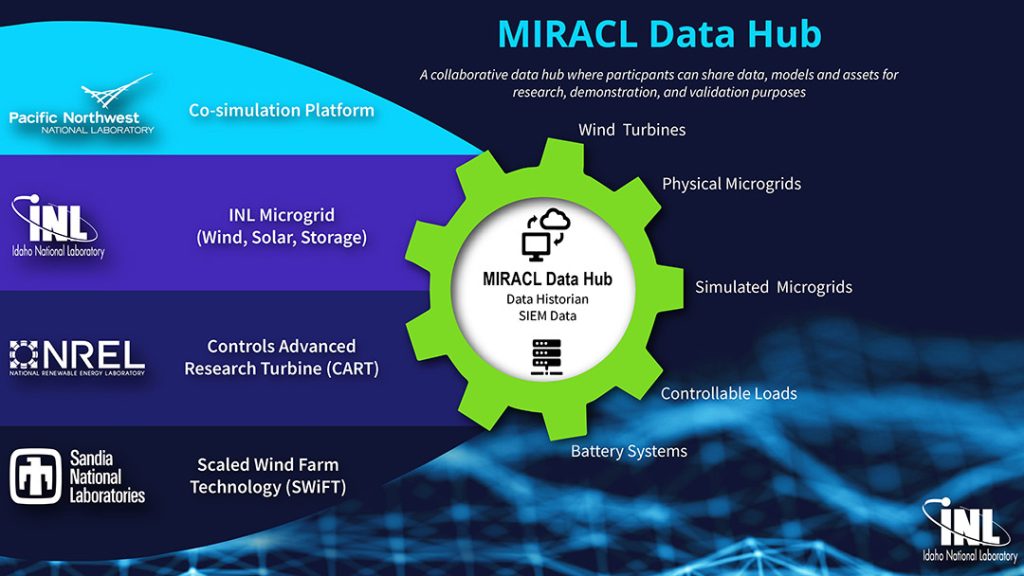
The MIRACL project focuses on securing wind infrastructure control systems, wind generation microgrids and hybrid distributed energy systems. The project is a collaborative effort among teams from Idaho National Laboratory (INL), National Laboratory of the Rockies (NRL), Sandia National Laboratories (SNL) and Pacific Northwest National Laboratory (PNNL), with funding from the U.S. Department of Energy’s Wind Energy Technologies Office. The MIRACL project seeks to equip and validate wind technology as a plug-and-play resource with solar, storage, and other DERs in hybrid systems. Collaborative research under MIRACL is enhanced by a new high-speed data platform that connects the data, models, and physical assets across the four laboratories.
Three Primary Research and Development Priorities of MIRACL
Priority #1
- Accurately value grid system contributions from wind as a distributed energy resource.
Priority #2
- Advance controls for wind hybrid distributed energy resource systems.
Priority #3
- Understand and guard against cyber threats in distributed wind applications.
MIRACL Research Benefits
- Improve the resilience and cybersecurity posture of the distributed wind community to become a source of aggregate energy generation on the electrical grid.
- Enable the distributed wind energy community to recognize threats and have real-time knowledge of attacks.
- Provide a platform enabling validation of hybrid DER system technologies to maximize grid support, resilience, and value for utilities and their customers.



Distributed Wind Cyber Threats & System Health
This research area seeks to leverage tools to advance an appropriate response to current distributed wind cybersecurity threats.
Cybersecurity Needs:
- Holistic evaluation of cyber-physical health of industrial control systems.
- Cost-effective and actionable sector-wide threat information sharing.
Cybersecurity Tools:
- ICS Resilient Security Technology (IReST)
- Structured Threat Intelligence Graph (STIG) with Structure Threat Information eXpression (STIX v2)
Quantifying & Improving Resilience
Focuses on quantifying and improving resilience by using modeling and simulation to visualize and manage the stability of operations of cyber-physical disturbances. Also seeks to benchmark how much capacity distributed wind can provide based on use cases and introduction of voltage and/or frequency support controls. Examines critical degradation factors such as transient stability, variability of resource, and voltage and/or frequency support controls.
The Need:
- No way to quantify the frequency of deterministic scenarios
- No way to quantify impact to system resilience
- Deterministic methods do not translate well to business justifications
The Goal:
Benchmark how much capacity distributed wind can provide based on use cases and introduction of voltage and/or frequency support controls.
The Solution:
- Uses power-flow-informed probabilistic-risk assessment for component failure
- Allows GridLAB-D to be used to incorporate distributed wind output
- Generates an adaptive capacity manifold to visualize and manage the stability of operations of cyber-physical disturbances
MIRACL Resources
Fact Sheets
Technical Reports
Videos
MIRACL Data Hub
The MIRACL Data Hub offers a collaborative environment where participants can share data, models and assets for research, demonstration, and validation purposes.
The MIRACL Data Hub is hosted by the High Performance Computing (HPC) resources offered through Idaho National Laboratory at the Collaborative Computer Center (C3). The High Performance Computing (HPC) resources provide scientific computing capabilities to support efforts in advanced modeling and simulation, while the C3 will become the hub for modeling and simulation at INL, with connections to Idaho’s three research universities and access for collaborators around the world.
Facilities & Equipment
CAES Turbine
The Center for Advanced Energy Studies (CAES) operates a Wind Turbine as part of the DOE Wind for Schools program. The 70-foot-tall wind turbine is located on the Idaho State University owned property at the CAES Campus. This turbine allows INL researchers and partnering universities, high schools and other educational institutions to access the performance data. The wind turbine’s operational data is also used by INL as part of the MIRACL program.
Resilience Control Lab
The Resilience Control Lab’s distinctive signature in Instrumentation Control and Intelligent Systems (ICIS) can be utilized for complex evaluation of control system designs for cyber security, advanced control, human performance and operational verification and validation. ICIS programmatic research is centered on developing components, programs, systems and individuals for any application that requires monitoring, control, security and human interaction.
Telecommunication Test Bed
The Telecommunication Test Bed has been used for nearly two decades to analyze, design, test, and improve cellular, radio, and satellite communication systems for government agencies and global wireless communication companies. As an internationally recognized leader in control systems cybersecurity and grid reliability, the laboratory can study, model, and perform unbiased, full-scale tests that illustrate the impacts of wireless failures in industrial processes.
Critical Infrastructure Test Range Complex and Power Grid
INL’s Critical Infrastructure Test Range Complex (CITRC), operated by INL, is a utility-scale electric power grid test bed. The electric grid is an operational, commercially-fed system that provides power to all of INL’s key research facilities on its sprawling, 890 square mile desert site; and includes: seven substations, a 24/7 manned dispatch and control center, 61 miles of 138kV transmission lines, and multiple distribution circuits at 15kV, 25kV and 35kV. Sections of the grid can be isolated and reconfigured for integrated testing and demonstration of state of the art power systems, components and smart grid technologies.
Recently completed enhancements to the test bed allow 65% of U.S. distribution class voltages to be represented with several User Sites and dual redundant fiber connectivity, instrumentation and SmartGrid interface test points. Loop-fed substations are linked with state-of-the-art Supervisory Control and Data Acquisition (SCADA) and a dedicated fiber-optic communication network. The electric grid test bed is operated under a full range of climatic conditions (temperature, wind, snow, ice, etc.), which mirror national grid conditions. Coupled with robust power systems engineering, modeling and analysis capabilities, the INL electric grid test bed is a unique capability across the DOE lab complex.
INL’s grid has been employed to validate and demonstrate the effects of existential threats such as Geo-Magnetic Disturbance (GMD). Infrastructure is currently under construction that will provide additional distribution- and transmission-class power equipment and control systems for use on new test pads with dedicated test facilities. Work is also underway with several DOE offices that will utilize the test grid to validate select protective relay security methodologies and demonstrate at scale the effects certain classes of cyber exploits could have on critical grid operations in microgrid configurations.
Microgrid Test Bed
The Microgrid Test Bed integrates simulation, storage systems, a intermittent energy microgrid, load control capabilities and full-scale testing. It includes solar panels, energy storage devices, load banks, smart inverters, a power distribution system and multiple switchgear sets. The system’s load control capabilities and grid interaction algorithms allow researchers to study demand response, peak shaving and ancillary services, and to test component interactions, performance, controls and integration challenges.
Battery Test Facility
As energy storage devices become more important for managing the world’s power supply, safeguarding large battery assemblies against catastrophic failure has become a top priority. Addressing safety, durability and reliability concerns, the Battery Test Facility offers a new, fast metric — self-discharge (SD) current — as a way to detect shorts and assess battery safety. The method is noninvasive and applicable to any battery chemistry or design.
Electric Vehicle Infrastructure Lab
Electric Vehicle Infrastructure Laboratory is designed to develop strategies for managing charging impacts on the electric grid. Experts have developed a software tool to aid in this research, Caldera. The foundation of the Caldera software platform is a library of high-fidelity EV charging models derived from extensive charging and battery testing data that INL has collected over the past decade. Caldera’s charging models accurately estimate charge power profiles, efficiency and power factors for a wide variety of vehicles and charging technologies under varying grid conditions. This capability is critical for predicting charging impact on the grid.
Real-time simulators: RTDS, OpalRT, HIL: Typhoon
Idaho National Laboratory’s advanced modeling capabilities can incorporate real-world data, hardware and software into real-time simulations. INL is equipped with the tools to test, validate and develop solutions for recent challenges facing the modern power grid. One Lab dedicated to this is the Power and Energy Real-Time Laboratory (PERL). The PERL approach to testing and refining a digital real-time simulator (DRTS) include the ability to integrate power systems hardware and software into hardware- and controller-in-the-loop (HIL) simulations.
Software Suites for Evaluating Cybersecurity, System Resilience, and Power Systems
Structured Threat Intelligence Graph (STIG)
Structured Threat Observable Toolset (STOTS)
Systems Analysis Programs for Hands-on Integrated Reliability Evaluations (SAPHIRE)
SAPHIRE creates and analyzes probabilistic risk assessments (PRA), primarily for nuclear power plants, but for other systems as well. Basic events — different parts and pieces that can fail in a given system — can be pumps or valves in a nuclear plant, computers, or batteries on a space shuttle. SAPHIRE can evaluate thousands of basic events and produce different possible failure scenarios.
Power Distribution Designing for Resilience (PowDDer) tool
Power Distribution Designing for Resilience Application (PowDDeR) is a software application to succinctly capture the capabilities of a power system to respond to disturbances, including natural or human (malicious or errors) caused disturbances. The software provides a measure of resilience for power systems.
Other Off-the-Shelf Software Toolkits Used by the MIRACL Team
PowerWorld
PowerWorld’s wide range of products provide the tools needed by transmission planners, power marketers, system operators and trainers, educators, and anyone else desiring access to power system information and analysis in a user-friendly format.
EasyPower
The EasyPower product suite delivers a full lineup of powerful Windows®-based electrical software tools for intelligently designing, analyzing, and monitoring electrical power systems. With the fastest processing speeds on the market, EasyPower delivers instantaneous, accurate results to help you make more intelligent decisions.
SKM
SKM is the leader in power systems analysis and design software for fault calculations, load flow, coordination, arc flash hazards, motor starting, transient stability, reliability, harmonics, grounding, cable pulling, and more. SKM software has been used in commercial, light and heavy industrial, institutional, utility, and petrochemical sites and facilities worldwide.
RSCAD®
RSCAD® is a user-friendly interface, intended to create a working environment familiar to the power system engineer. It allows the user to perform all of the necessary steps to prepare and run simulations, and to analyze simulation results – all without the use of third-party products, which can be difficult to maintain and troubleshoot.
PSS®E
PSS®E allows you to perform a wide variety of analysis functions, including power flow, dynamics, short circuit, contingency analysis, optimal power flow, voltage stability, transient stability simulation, and much more.
PSLF
Effective power system analysis often requires large-scale simulations and manipulation of large volumes of data. When performing these analyses, efficient algorithms are just as important as the engineering models in which the data is used. GE Energy Consulting recognizes these imperatives, and has developed GE PSLF. A complete set of tools allows the user to switch smoothly between data visualization, system simulation, and results analysis.
ASPEN
Well known for speed, ease-of-use and accuracy, ASPEN software is the favorite tool of power industry engineers in large and small companies worldwide. ASPEN software is industrial strength: OneLiner and Power Flow can handle with ease networks with over 100,000 buses. DistriView can handle radial or looped distribution feeders with up to 32,000 nodes.
Collaborate with MIRACL
Provide access to hardware/software for cyber R&D
- What systems do you think are important to consider?
- Are there past DER cyber reports or approaches that you recommend we consider?
Collaborate on cyber and resilience tools development and verification
- Which cybersecurity tools do you use and/or are important for us to consider?
- What would you like cybersecurity tools to do (that they may not do today)?
- Which tools that you use could benefit from updates?
Provide input on Modeling and Simulation for Targeted Electrical Resilience Improvements (MASTERI)
- What case-studies would you recommend we start with?
- What microgrid infrastructure requirements and performance data are you aware of?
- Would you consider sharing your system information?